the Shadow (The thread of)
Narrative
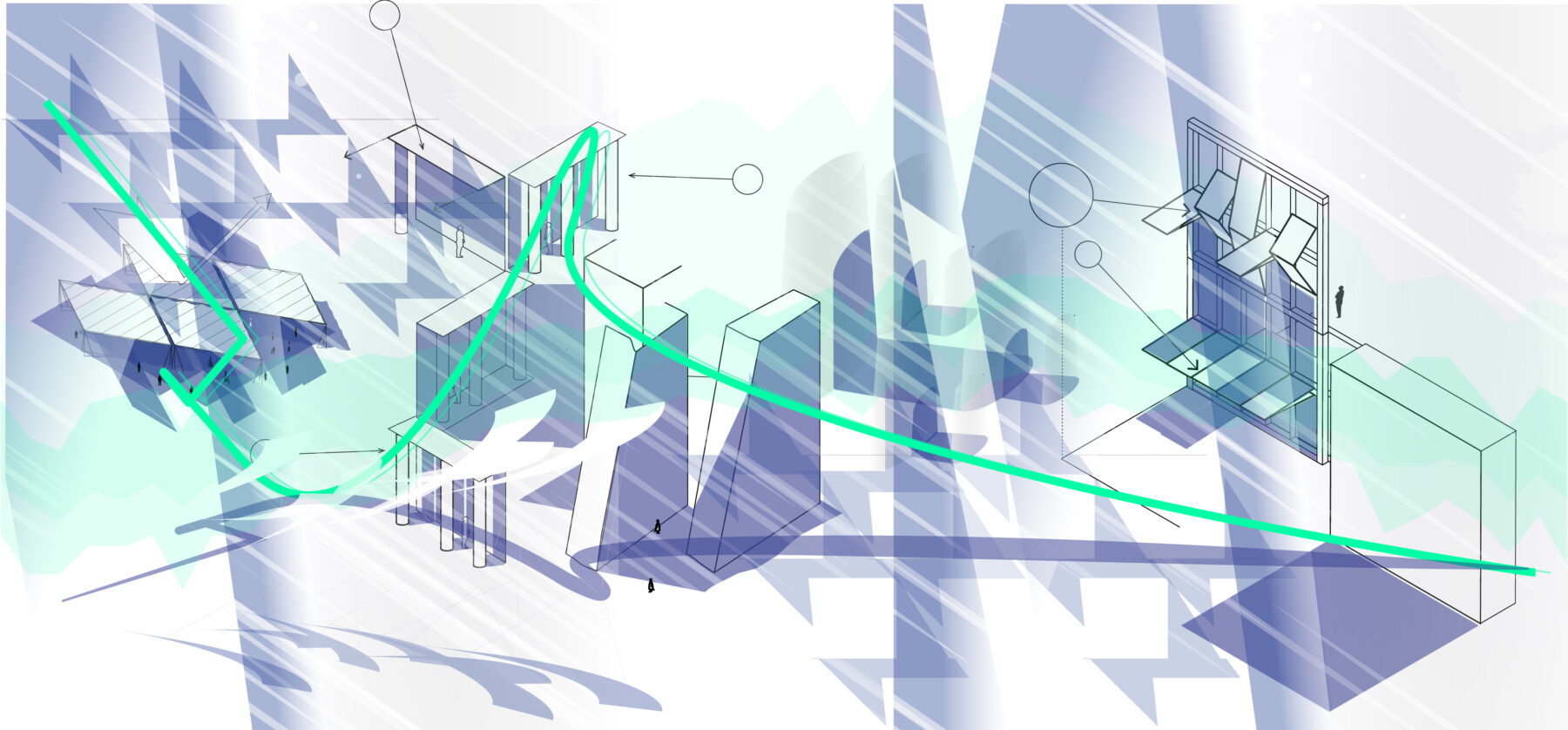
There is an invisible geometry that runs through our cities, our bodies, our hearts. A moving, intangible, yet decisive geometry: that of shadow.
Shadow is not the opposite of light. It is its other name, its reverse, its immediate memory. It is born from it, attached to it, escapes from it. And it is perhaps this duality that makes it such a special substance: elusive yet structuring, absent yet active. It is also a link between oneself and space, between the shadowed and the shadower.
Shadow is also music, when the alternation between light and dark is rhythmed along a concrete and glass corridor—as in La Tourette, designed by Le Corbusier. This is where a form of spatial polyphony is born, which goes beyond the optical: a vibration, a listening to the place.
But in the contemporary fabric of the city, shadow has become persona non grata.
In our hygienist, rationalist Northern cultures, shadow is a nuisance. It blocks light and transparency. Urban planning has inherited this fear: we light, we ventilate, we standardize. The Civil Code measures distances and prospects, never shadows. What is measurable becomes acceptable. What is not becomes a problem.
And yet, in the South, shadow is the first response. It precedes the plan. It guides the layout. In the medina, it is shadow that draws the street. In Bologna, it forms the basis of public space under the arcade. It is more than an effect; it is a principle.
Building with shadow means designing differently. It is not about placing an object in a site, but thinking about a skin, an interface, a filter. The shadow thus produced is not passive decoration: it is an active response to an environment—a climatic tool.
But we must relearn how to listen to it.
Shadow cannot be measured directly. It eludes conventional instruments. It moves, it dances, it hides. What we can measure are its effects: radiant temperature, perceived coolness... Shadow is a hidden but essential variable.
And in a world where climates are changing, it is becoming a precious resource.
We must start designing urban forms today that are capable of generating their own shade. Buildings that protect themselves. Streets that offer respite. Thresholds, passageways, arcades. Not as picturesque elements, but as structures for survival.
A proto-thread of shade—tenuous but tenacious—connects architecture and climate, body and environment. This thread spans centuries and cultures. It winds around a tree, spreads across a white wall, penetrates a patio. It outlines the conditions for a renewed way of living together.
This thread must be retightened. Reactivated. Because shade, far from being an absence, is an active presence. An indicator of climate intelligence. A catalyst for uses.
It is by following the thread of shadow that we can, perhaps, rediscover a form of lucidity. That of a city that does not impose, but adapts. That does not spread out, but filters. That does not only measure, but feels.
What if tomorrow, in our latitudes, building meant above all learning to weave shadow?
Contribution
From the book "Les 101 Mots de l'Adaptation, à l'usage de tous", under the direction of Atelier Franck Boutté
Title
the Shadow (The thread of)
Authors
Franck Boutté, President, and Elise Lenoble, communication manager at Atelier Franck Boutté
Editor
Archibooks
Publication date
2025
Pages
176 pages
Illustration
Sébastien Hascoët
Franck Boutté
/ Founding Chairman

Elise Lenoble
/ Communications Manager